
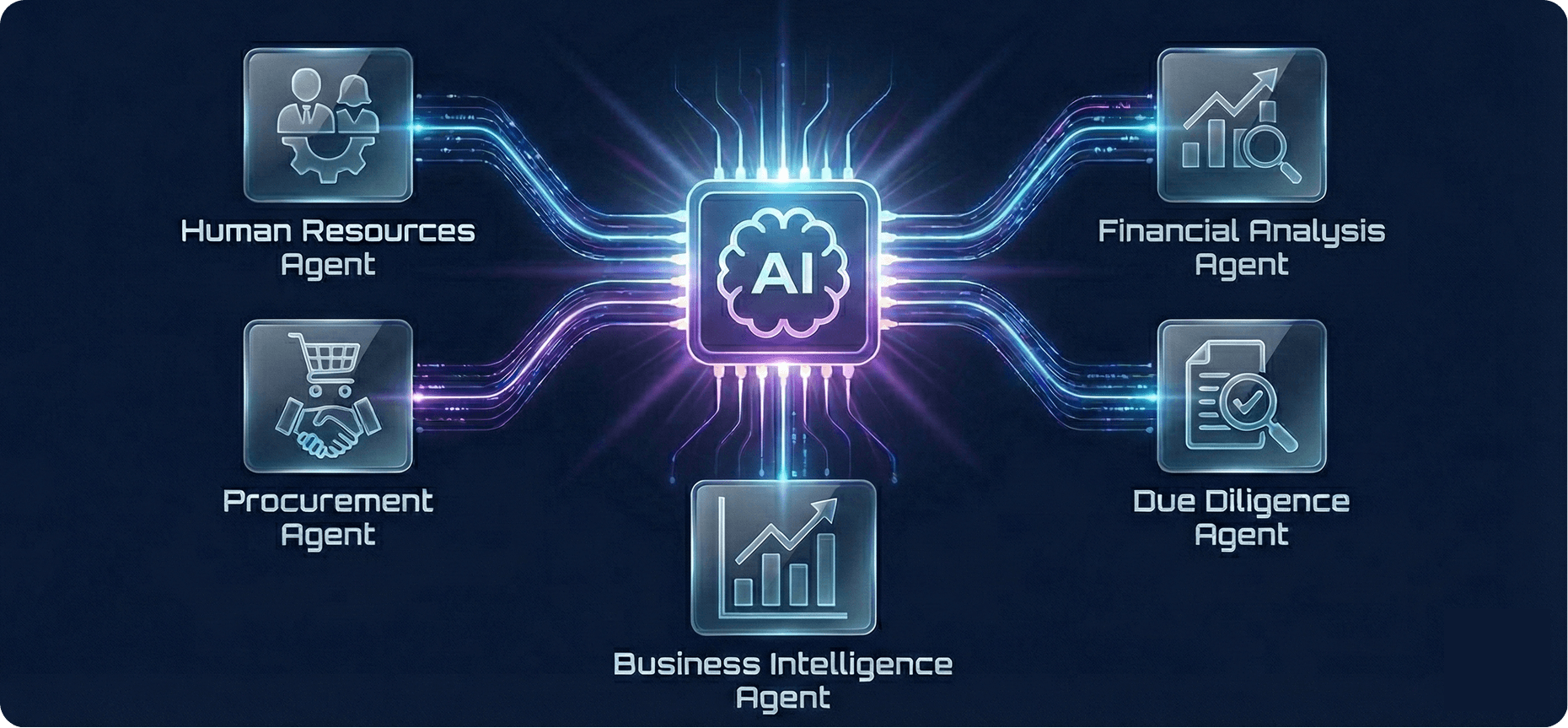
Examples of AI agents are systems that can plan and execute multi-step actions to achieve a goal, often by interacting with tools, data, and other software systems.
Common AI agent examples include a sales lead-qualification agent that scores and routes leads while updating a CRM, a support resolution agent that diagnoses issues and triggers fixes, a data reporting agent that validates freshness and alerts stakeholders, and an operations agent that completes internal requests from start to finish.
Unlike chatbots, which answer questions and stop, AI agents continue working until the task is completed or escalated.
What counts as a real AI Agent example?
Before listing examples, it’s important to draw a clear line.
An AI agent is not:
- A chatbot that answers questions
- A single prompt that generates text
- A one-off automation that runs once
A real AI agent:
- Has a goal
- Breaks that goal into steps
- Uses tools or systems
- Adapts based on results
- Continues until the outcome is reached
Want a deeper understanding? See our guide on what agentic AI actually is.
Why businesses are investing in AI Agents
The shift toward AI agents is driven by one simple reality: businesses want work done, not just answers.
According to McKinsey’s research, activities that account for up to 30% of hours worked could be automated by 2030, especially in functions like sales, operations, and analytics.
This explains why companies are moving beyond chatbots and experimenting with agentic systems that can act independently.
Examples of AI Agents by business function
Below are practical, real-world AI agent examples that companies are exploring and deploying.
1. Sales lead qualification agent
What the agent does:
- Monitors inbound leads from forms, chat, and email
- Analyzes firmographics and behavioral signals
- Asks follow-up questions when data is missing
- Scores leads dynamically
- Routes qualified leads to the right rep
- Updates CRM records automatically
It doesn’t just score leads. It decides, acts, and keeps going until qualification is complete.
2. Sales follow-up and CRM hygiene agent
What the agent does:
- Monitors meetings, calls, and email threads
- Drafts personalized follow-ups
- Schedules reminders or next meetings
- Updates pipeline stages and notes
- Flags stalled opportunities for review
This type of agent removes one of the biggest friction points in sales: administrative overhead.
3. Customer support agent
What the agent does:
- Reads incoming tickets
- Classifies urgency and issue type
- Pulls account and usage history
- Attempts resolution using tools and knowledge bases
- Executes fixes (refunds, resets, config changes)
- Escalates edge cases with full context
Support teams increasingly rely on automation here. Salesforce’s State of Service report shows that AI-powered service tools help teams resolve cases faster while reducing agent workload.
4. Marketing campaign optimization agent
What the agent does:
- Monitors email and ad performance
- Identifies underperforming segments
- Tests variations in copy or targeting
- Adjusts spend allocation
- Pauses ineffective campaigns
- Reports outcomes to marketers
This is not a static workflow. The agent observes, decides, and acts repeatedly.
To know more about building a marketing AI Agent, see how to create agentic AI workflows for marketing and sales.
5. Content operations agent
What the agent does:
- Pulls content briefs from a backlog or CMS
- Generates drafts aligned with brand guidelines
- Checks SEO basics and tone
- Routes drafts for human review
- Publishes approved content
- Tracks performance and suggests updates
This kind of agent is increasingly common in content-heavy teams.
6. Data analytics and reporting agent
What the agent does:
- Pulls data from warehouses and APIs
- Validates freshness and quality
- Runs predefined analyses
- Generates summaries and dashboards
- Alerts stakeholders to anomalies
- Answers follow-up questions with context
Many of these agents rely on secure access to internal data. This is where retrieval-augmented agents help.
7. Procurement and vendor evaluation agent
What the agent does:
- Reviews supplier proposals
- Extracts pricing and key terms
- Applies business rules and risk checks
- Compares vendors against criteria
- Flags compliance issues
- Recommends shortlists
These agents are especially valuable in finance-heavy or regulated environments.
8. HR onboarding agent
What the agent does:
- Triggers onboarding workflows
- Provisions accounts and tools
- Answers policy questions
- Tracks task completion
- Escalates blockers
- Maintains an audit trail
This reduces HR workload while improving the new-hire experience.
9. Internal operations agent
What the agent does:
- Responds to internal queries
- Executes approved actions
- Tracks requests to completion
- Logs actions for compliance
These agents are common in IT ops, finance ops, and people ops teams.
What all these AI Agent examples have in common
Across all examples of AI agents, notice these patterns repeat:
- Clear, outcome-based goals
- Multi-step execution
- Integration with real tools
- Memory and context
- Human-in-the-loop for edge cases
If any of these are missing, you’re likely looking at a chatbot or a script, not an agent.
How companies start with AI Agent pilots
Most teams don’t deploy dozens of agents at once.
They start with:
- One workflow
- One team
- One clear success metric
Short pilots prove value before scaling.
You can see common starting points in our guide on the top use cases for agentic workflows.
How JADA builds Production-Ready AI Agents
Many companies experiment with AI agent examples but struggle to operationalize them.
The JADA Squad focuses on:
- Agents embedded in real business systems
- Clear permissions and safety controls
- Human-in-the-loop by design
- Documentation and long-term ownership
Want to build a custom AI Agent for your business? Talk to our experts today!
Frequently Asked Questions
What is an example of an AI agent?
A sales lead-qualification agent that analyzes leads, asks follow-up questions, routes prospects, and updates a CRM is a common real-world example of an AI agent.
Are AI agents the same as chatbots?
No. Chatbots respond to prompts, while AI agents can plan and execute actions to achieve goals.
Where are AI agents used today?
AI agents are used across sales, marketing, customer support, data analytics, HR, procurement, and internal operations.
Do AI agents replace humans?
AI agents automate repetitive and structured work, while humans focus on strategy, judgment, and oversight.
How do you build an AI agent?
Building an AI agent involves defining goals, integrating tools, adding planning logic, memory, guardrails, and deploying with human oversight.
